A look inside
The same clean, themeable interface as the rest of the suite.
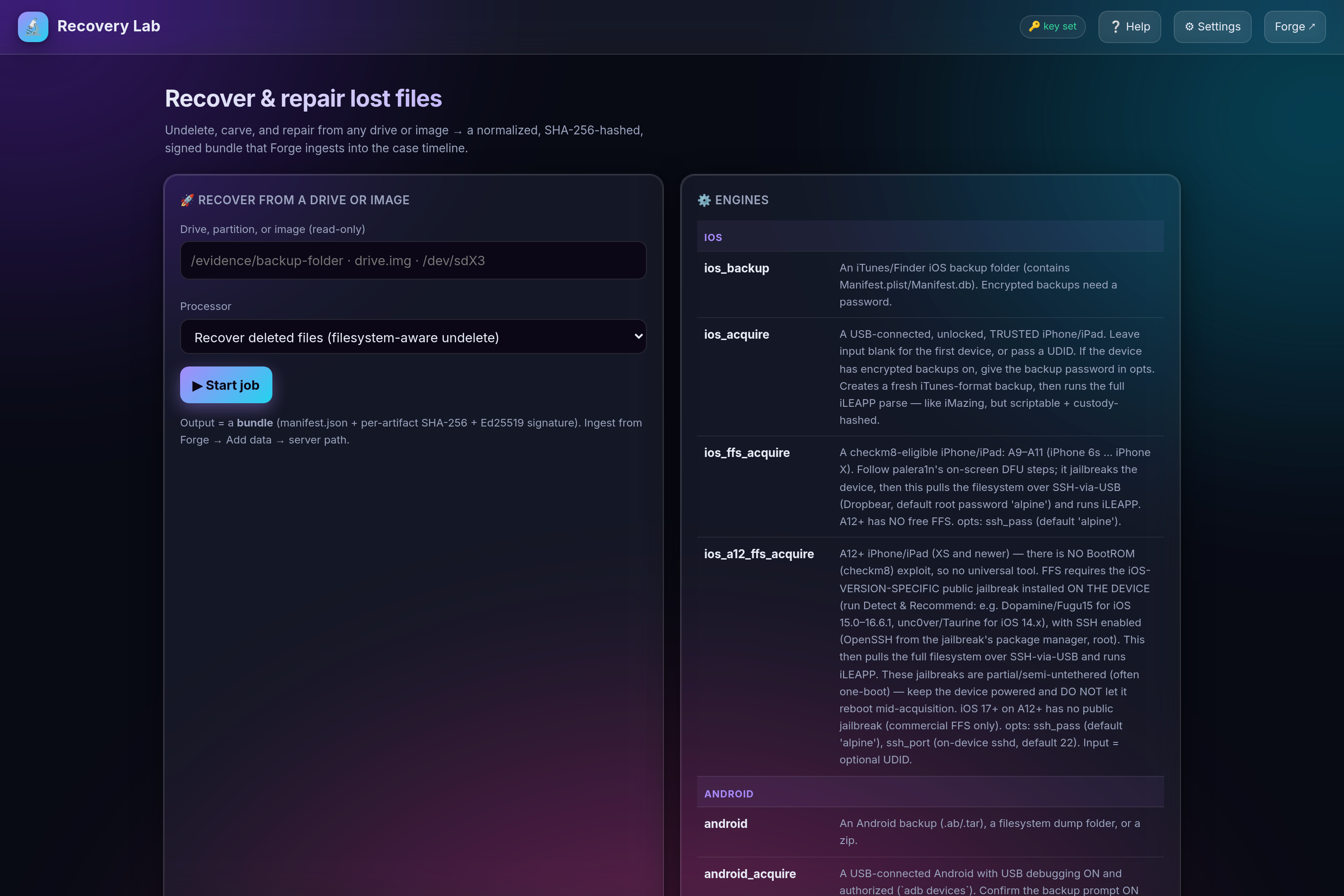
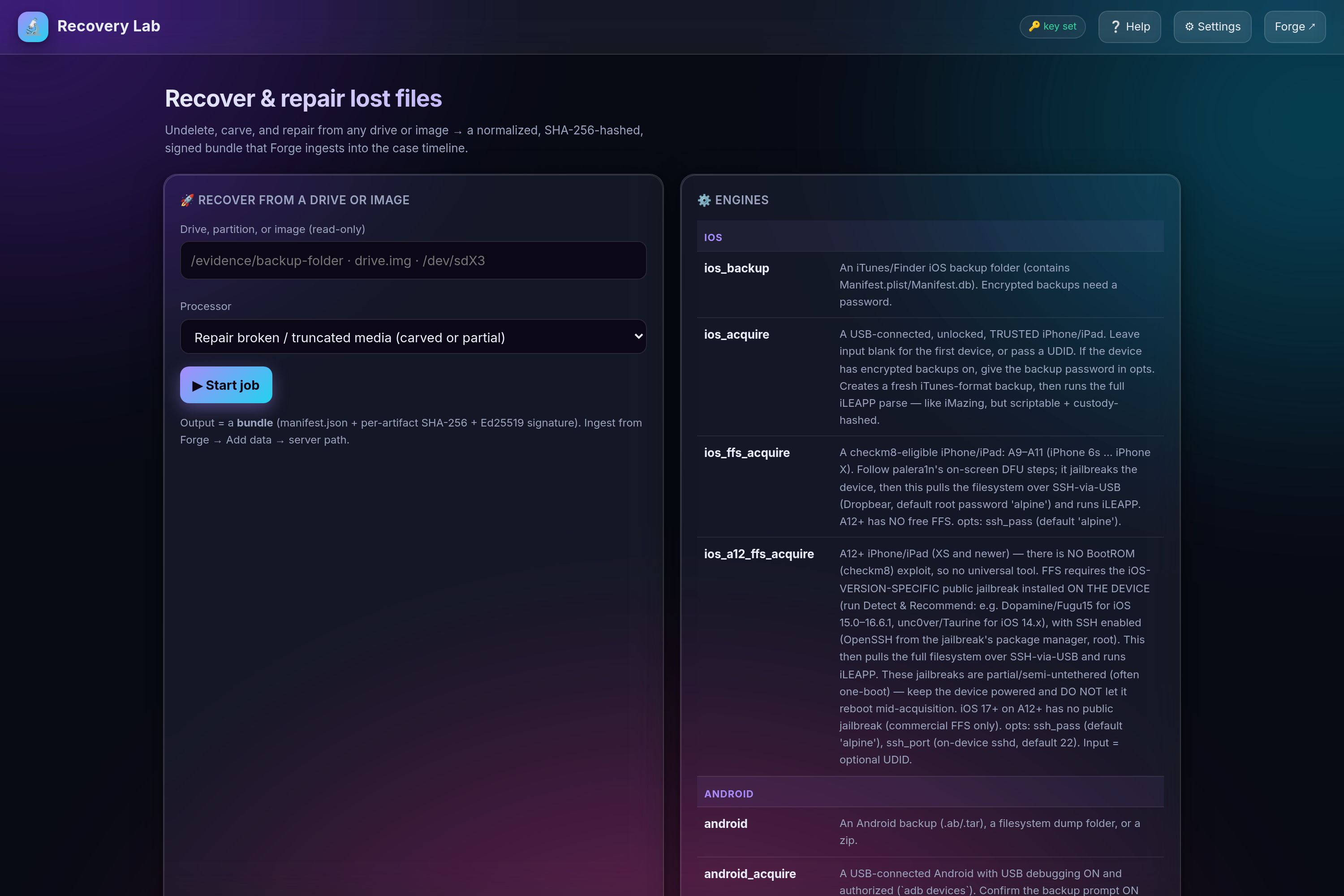
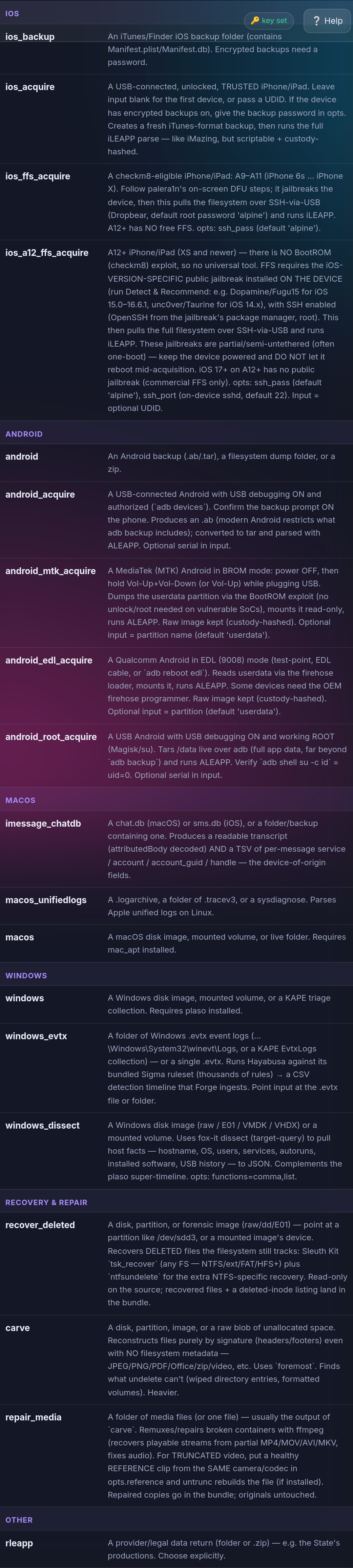
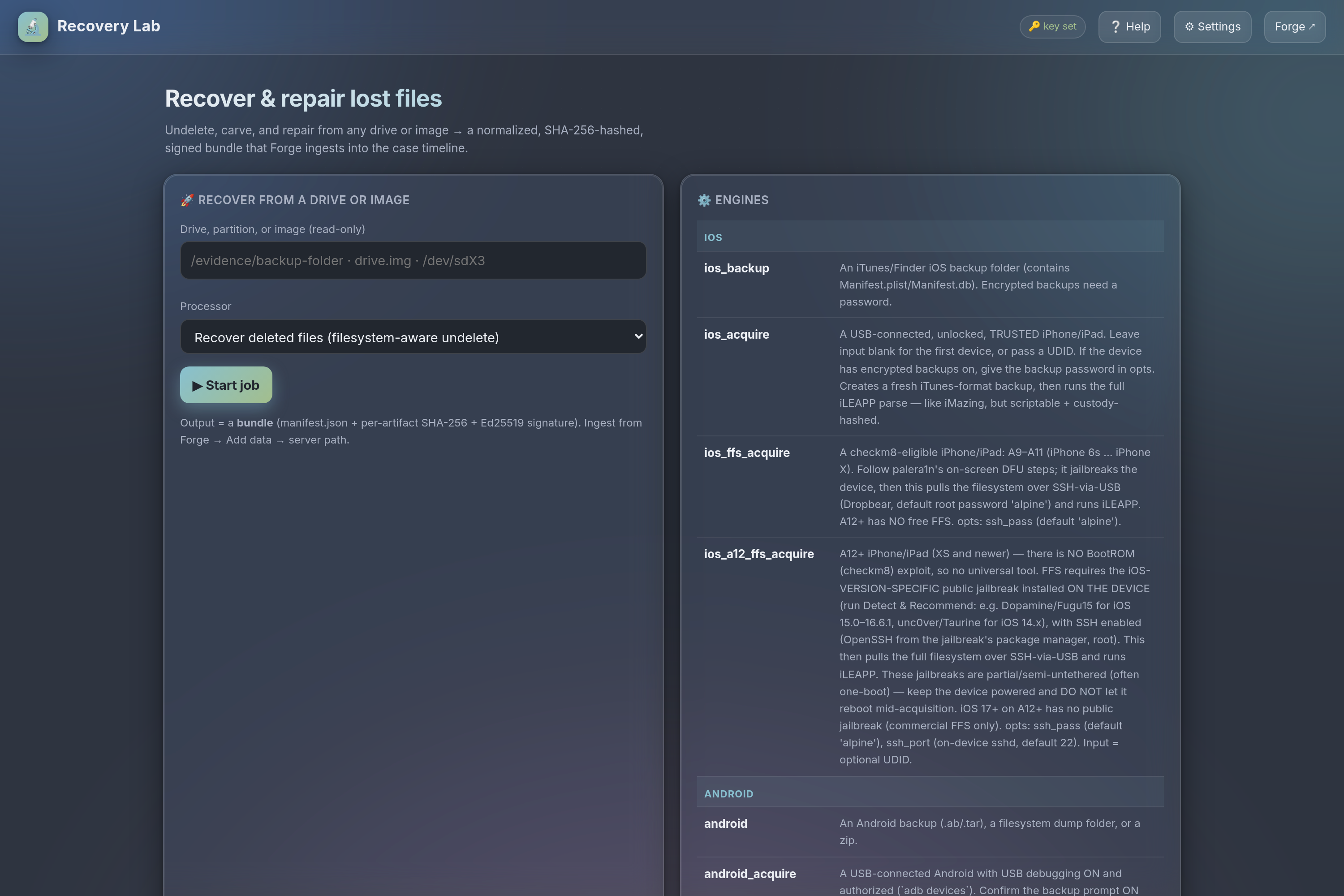
Recovery Lab undeletes files, carves data off formatted or wiped drives, and repairs broken or truncated photos, audio and video — into a hashed, signed bundle you can trust.
Self-hosted, read-only on your source media, nothing uploaded. The recovery engine that powers Crucible's forensics — available on its own.
A deleted file, a quick-formatted SD card, a phone backup that won't open, a video that cuts off halfway — most "lost" data isn't actually gone. Recovery Lab is a self-hosted workstation that recovers it three ways — filesystem-aware undelete, signature carving, and media repair — and writes the results to a SHA-256-hashed, signed bundle. Built on the same deterministic engine that backs Crucible's court work, so it's clean enough for a case and simple enough for a Saturday rescue.
Point it at a drive, a partition, or a disk image — and pick the right tool, or run them all.
Filesystem-aware recovery (NTFS, ext, FAT, HFS+) with the Sleuth Kit and ntfsundelete — brings back files the filesystem still tracks, with their names and a deleted-inode listing intact.
Reconstructs files by signature when there's no filesystem left — photos, PDFs, Office docs, video, archives — recovered from a quick-formatted or corrupted volume's unallocated space.
Remuxes and rebuilds broken or truncated audio and video — recovers the playable portion of a partial clip, and rebuilds truncated MP4/MOV from a healthy reference file from the same camera.
A complete salvage pipeline — image, recover, repair, export.
Built-in ddrescue clones a dying or flaky disk to an image — with a map file — so every recovery step runs on a safe copy and never stresses the failing hardware again.
Sleuth Kit tsk_recover + ntfsundelete recover deleted files across NTFS, ext, FAT and HFS+ — with original names and a full deleted-inode listing for the report.
foremost, scalpel and photorec reconstruct files from raw unallocated space by header/footer — finding what undelete can't, even after a format.
ffmpeg salvages playable streams from partial files; untrunc rebuilds truncated video using a healthy reference from the same device. Turns carved fragments back into playable clips.
Every job's results are catalogued with per-file SHA-256 and an Ed25519 signature over the bundle — re-verifiable later, court-ready, and ingestible straight into a case.
Recovery Lab never writes to the media it reads. Mount read-only or work from an image — your evidence (or your only copy) is never altered.
Damaged or deleted, on a drive or an image — to a clean, hashed bundle.
Point ddrescue at a dying drive to clone it to a safe image first. Healthy media? Skip straight to recovery — read-only.
Run filesystem-aware undelete to bring back tracked-but-deleted files with their names — across NTFS, ext, FAT and HFS+.
Signature-carve the unallocated space for everything the filesystem no longer tracks — formatted, wiped, or orphaned files, by type.
Remux partial clips and rebuild truncated video so the carved fragments actually play — keep a small reference-clip library per camera for the best results.
Everything lands in a hashed, signed bundle — open the files directly, or ingest the whole thing into a Crucible case timeline.
Recovery-shop power, on your own terms.
Runs on your hardware — your data never leaves the building, and there's no per-job cloud fee or a stranger handling your drive.
Deterministic open-source engines (Sleuth Kit, foremost, photorec), read-only sourcing, hashed + signed output — defensible if it ever matters.
Most tools stop at carving and hand you broken fragments. Recovery Lab repairs the media too, so partial clips actually play.
No arcane command lines — point at a drive or image, pick a mode, get a bundle. The same polished UI as the rest of the suite.
NTFS, ext, FAT, HFS+, raw images, SD cards, USB drives, disk images — Windows, Mac and Linux media all welcome.
Built and supported by Richey Business — you can actually reach us.
Recovery Lab is included in Crucible — and the recovered files drop straight into a case.
Recovery Lab ships as the Recovery & Repair capability inside Crucible's Extraction Studio — every recovered or repaired file flows into the same UTC-normalized, chain-of-custody case timeline, alongside phone extractions and OSINT. Need recovery without the full forensic platform? Recovery Lab stands alone too. Explore the full Crucible suite →
The same clean, themeable interface as the rest of the suite.
Recovery shops, IT teams, investigators, or anyone who just lost something they can't lose — book a walkthrough, or talk to us about a private, self-hosted deployment.